Transcript
Announcer:
You’re listening to GI Insights on ReachMD, and this episode is sponsored by Ardelyx. Here’s your host, Dr. Brian McDonough.
Dr. McDonough:
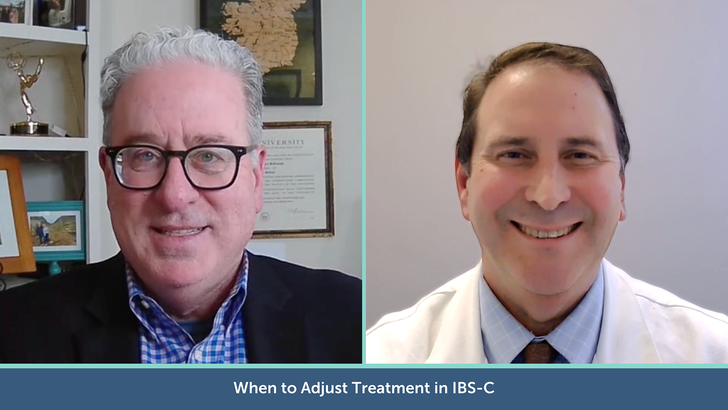
This is GI Insights on ReachMD, and I'm Dr. Brian McDonough. Today, I'm joined by Dr. Brooks Cash to discuss early treatment adjustments in the management of irritable bowel syndrome with constipation, also known as IBS-C. Not only is Dr. Cash a Professor of Medicine at Texas A&M, but he also serves as the Medical Director of the Functional Bowel Center at Baylor University Medical Center. Dr. Cash, welcome to the program.
Dr. Cash:
Thank you very much. It's great to be here.
Dr. McDonough:
To start us off, Dr. Cash, what's an appropriate timeframe to evaluate treatment response and IBS-C, and what signals clue you in that it might be time to consider a change?
Dr. Cash:
That's a great question, and I think it's quite varied with regards to current practice. So when we treat irritable bowel syndrome with constipation, we generally recommend initiating therapy with simple things that patients have really a lot of autonomy with. So that includes lifestyle modifications, dietary modifications, and exercise and activity level, as well as over-the- counter therapies. And generally, we recommend bulking agents or fibers, along with osmotic laxatives that are over the counter.
Now, in terms of the data to support those approaches, there are people who will get better with that. But generally, what we've found—and this is included in many of our guidelines— is that, especially those therapies such as the bulking agents and the osmotic laxatives, they don't do such a great job at improving abdominal pain. And that's one of the central symptoms that patients with IBS-C experience: abdominal pain or discomfort associated with their constipation.
So if patients don't respond to those symptom improvements or those goals—and I always say to patients, what are the top three symptoms that you're experiencing? I don't feed them to them. I ask a very open-ended question, so that I know what I can try and focus on first. I try to be realistic with them. If their symptoms of pain or discomfort don't get better within the first four weeks of those therapies, then I will initiate pharmacologic therapy. And in terms of pharmacologic therapy, I generally will give them a little bit longer to respond to those types of therapies—typically eight to 12 weeks, especially for the abdominal pain or discomfort.
Dr. McDonough:
With that being said, how do you employ therapies with different mechanisms of action?
Dr. Cash:
That's a great question. So when we think about our armamentarium, I already alluded to the lifestyle modifications, then an osmotic laxative, many of which are over the counter. We then escalate when patients don't have a satisfactory response, whether it's for their defecation symptoms, their straining, their incomplete evacuation, their hard lumpy stool, their infrequent bowel movements, or their abdominal symptoms. Remember, we're trying to treat both in patients with IBS with constipation—their abdominal pain, their discomfort, and their bloating or distension.
We have, for FDA-approved therapies, a group of therapies that are called secretagogues, which work by bringing ions and fluid into the gut lumen. We also have retainagogues, which work by retaining ions and fluid in the colon.
And I also have a group of therapies that I often will use with different mechanisms of action that are indicated for chronic idiopathic constipation, which is simply constipation or irritable bowel syndrome with constipation without the abdominal pain or discomfort being central to the patient. So they're very closely aligned diagnoses and really just semantically different, and I will use prokinetics in these patients. I'll give them a concomitant diagnosis of chronic idiopathic constipation. And those are agents that work by signaling or working through the serotonin pathway.
So I'll use those different mechanisms, sometimes together, to try and create a synergistic effect in patients if they don't have a complete response or a satisfactory response. Generally, we start with the secretagogues or the retainagogues in these patients, though.
Dr. McDonough:
Now, in day-to-day practice, how can clinicians distinguish between a patient who needs more time on therapy versus one who has reached a treatment plateau?
Dr. Cash:
Yeah, that's a tough question, because every patient's slightly different in terms of their expectations as well as their level of satisfaction. So I think we have to take each patient individually. We need to ask them, how are their symptoms doing relative to what they've experienced in the past? And there's of course the retrospective scope, and there's the bias of time.
But are their symptoms impacting their quality of life, their daily life, and their activities of daily living? And then we just have to frankly ask them, do you want to try an additional therapy or try something different? Do you want to switch to something different?
We're realizing that there may be some frustrations in even achieving those medications. There may be some cost included. There may be some side effects of those medications. So it's a very individualized decision that I think you have to really specifically tailor to each patient.
Dr. McDonough:
For those just tuning in, you're listening to GI Insights on ReachMD. I'm Dr. Brian McDonough, and I'm speaking with Dr. Brooks Cash about how timing influences treatment success in IBS-C management.
So, Dr. Cash, from a practical standpoint, what are some steps clinicians can take to build early switch decision points into their follow-up workflows without adding unnecessary complexity?
Dr. Cash:
What I'm generally doing in those circumstances is I'll talk to the patient about their primary symptoms that are most bothersome to them and what they want to see change. And then we'll establish some parameters around when we decide that we're going to consider this a failure or consider this a success.
With defecation symptoms, those tend to respond faster to not only our over-the-counter therapies, but also our prescription therapies. So I have a shorter timeframe for those symptoms—typically anywhere from one to two weeks. I tell patients, if you haven't seen a change in your bowel movements in terms of their frequency, their consistency, or the ease of defecation, let me know.
We'll talk about other options for abdominal pain or discomfort. It takes longer. There's neuroplasticity, and there's this concept of visceral hypersensitivity that's at play in a lot of these patients. And those changes to the enteric neurons and the signaling between the central nervous system and the enteric nervous system take time to resolve. They're not just a light switch.
So I really try to get patients to drag that out and give those therapies an adequate trial. And generally, that's eight to 12 weeks in terms of reassessing those symptoms. And then when I do that, we have to grade it. Are you 50 percent better? Are you 75 percent better? Are you no better at all? Would you like to add something? It becomes somewhat of a trade-off often in patients to try and decide what we want to do in terms of managing those symptoms. And it doesn't always require additional pharmacologic therapy.
Dr. McDonough:
And when you're discussing all of this with your patients, how do you communicate treatment expectations and prepare them for potential therapy changes?
Dr. Cash:
That's a really important question and a really important point. What I tell patients is, there are very few things in life that are perfect, and I don't want them to expect that we're going to eliminate all of their symptoms. I call irritable bowel syndrome the AFib of the GI tract. It's irregularly irregular. Patients can go for prolonged periods of time with minimal symptoms and then have prolonged periods of time with bothersome symptoms. So what I try to convey to them is that we're going to try to even out the sine wave of their symptoms—the dips and valleys of their symptoms. We're looking for consistency and satisfaction over time, but not necessarily a complete fix.
And so I think setting those expectations that there may be some residual symptoms that occur and that they should be looking for triggers to those symptoms can be very helpful. And it also resets the expectations for not only patients, but also myself in terms of treating these patients.
Dr. McDonough:
Before we wrap up our conversation, Dr. Cash, do you have any key takeaways you'd like to leave with our audience?
Dr. Cash:
I think it's important to recognize that irritable bowel syndrome with constipation is a very impactful condition. I would encourage our audience to become familiar with the Rome criteria, number one, and ask those questions that fit the Rome criteria when making this diagnosis, which is really a diagnosis that you can make by talking to patients. It's not a diagnosis of exclusion, but make them according to the Rome criteria.
And then talk to patients with regards to how their symptoms are impacting their lives and have the patients tell you what types of symptoms they feel like they would most want to address. And by doing that, I think it shows patients that we're listening to them, that we are taking every opportunity we can to help them in terms of why they came to see us, and that we're partners with them in this journey to try and help their symptoms.
So those would be the major things that I would try to convey to our audience that might help them take care of these patients in the future.
Dr. McDonough:
I think it's important you stress the partnering—that's a really good idea. With those final insights in mind, I want to thank my guest, Dr. Brooks Cash, for joining me to discuss how early switching can improve outcomes in IBS-C care. Dr. Cash, it really was great having you on the program.
Dr. Cash:
Thanks so much.
Announcer:
This episode of GI Insights was sponsored by Ardelyx. To access this and other episodes in our series, visit GI Insights on ReachMD.com, where you can Be Part of the Knowledge. Thanks for listening!